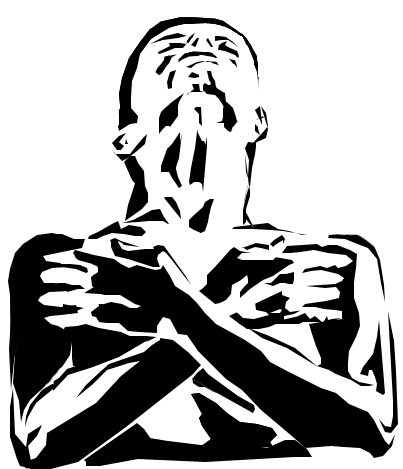
Charles Cooley (1864-1929) was another American sociologist most famous for articulating the "looking-glass self" concept.
According to Cooley, in his work "Human Nature and the Social Order", his "looking-glass self" involved three steps:
1) To begin, we picture our appearance of ourselves, traits and personalities
2) We then use the reactions of others to interpret how others visualise us
3) We develop our own Self-concept, based on our interpretations. Our Self-concept can be enhanced or diminished by our conclusions. [Source]
I think what Cooley was describing was simply the Nafs, the Ego-self, and how the Ruh, or the spirit, has been corrupted through a self-absorbed ego molding the individual into a social pawn. More on this in an earlier blog.
Showing posts with label Medical Theory. Show all posts
Showing posts with label Medical Theory. Show all posts
1/2/07
Talcott Parsons
Talcott Parsons (1902-1979) was a famous American sociologist involved with analyzing the performance of societies and the roles of individuals within it. He put his theories into a series of books on sociology.

His influence towards the practice of medicine was in addressing the "Sick role" concept. Parsons argued that society must control and prevent sickness amongst its populace to secure its functionality. The populace is controlled, or channeled/conditioned, by "social norms" into a working system.
1). exemption from work roles
2). lack of moral culpability for sickness
3). incapable of overcoming it alone
4). expert help to be sought
Our lecturer seemed rather proud of Parsons, she even put his "Sick Role' up on the exam. Although I really doubt the importance of his contribution to medicine. I think beyond the "system" there is a basic human desire to save one's kin...etc and hence a supply of doctors and hospitals arise out of the society's demand for them. The more interesting question is, in a theocratic society, how the thresholds of healers interfere with the divine healing theories theocracies usually support. M-hmm.
1/1/07
What is Medicine?
First day of medical school, makes sense that the first lecture will be entitled "What is Medicine?"
My lecturer spent a lot of time talking about The Sociological Imagination, 1959, by C. Wright Mills in explaining how we must see individuals through a "sociological imagination" and put in mind their perspectives of Culture, History, Emotion, Structure, Spirituality, and Critique (CHESS-C mnemonic). I thought it was a little bit interesting, but also a little lame, because, like, soon globalization will turn all the humans into an English-speaking consumer population anyway.
Then the lecture went into traditional healers, paradigm shifts, the changing perspectives on masturbation (the 1900 generation apparently blamed the act on tight nappies as infants) and homosexuality.
I think in a later lecture sometime someone introduced a more succint and more definitive definition of medicine taken by the preamble to the World Health Organization's constitution as being:
"...a state of complete physical, mental and social well-being and not merely the absence of disease or infirmity." [source]
Subscribe to:
Posts (Atom)